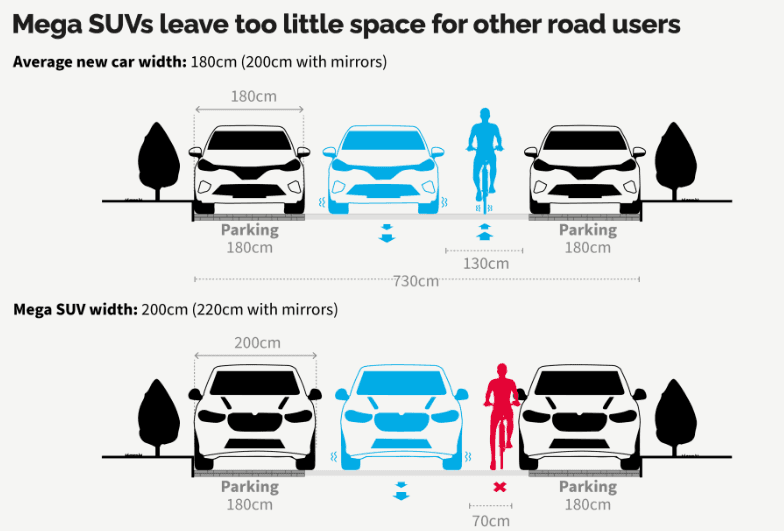
A new study has highlighted a significant trend in the automotive industry: the increasing size of new cars. Over the past two decades, cars have been growing wider by approximately 1 cm every two years, leading to challenges in fitting into standard parking spaces. The average width of a new car now exceeds 180 cm, up from just over 170 cm in 2001. This change has sparked concerns among drivers and urban planners, as most on-road parallel parking bays have traditionally been 180 cm wide. The campaign group Transport and Environment, which analyzed new car registrations across the EU and the UK, warns that this trend towards bigger vehicles could create problems on roads and in urban areas.
Richard Hebditch, the UK director of Transport and Environment, expressed concerns about the impact of larger cars on urban spaces. He noted that as cars get bigger, they not only squeeze out space for other vehicles but also create parking difficulties. Vehicles exceeding their parking bays encroach upon space meant for pedestrians and other road users.
The report attributes the growth in car size partly to the increasing popularity of larger sport utility vehicles (SUVs). Models like the hybrid-electric BMW XM, measuring 200.5 cm, and the Range Rover Sport at 199 cm, are among the widest on the market. In contrast, models like the latest Volkswagen Golf are about 180 cm wide, excluding wing mirrors.
This trend raises questions about the design and size of parking spaces. Despite growing vehicle sizes, parking bay dimensions in the UK and continental Europe have remained largely unchanged for decades. The Chartered Institute of Highways and Transportation set the standard parking space size in the 1970s at 180 cm wide and 4.8 m in length, a standard that has been widely adopted across Europe.
In response to these changes, the British Parking Association in 2022 suggested that parking bays should be widened to 260 cm. This recommendation aims to make parking easier and reduce the risk of damage to vehicles. Recent figures from the Society of Motor Manufacturers and Traders showed that SUVs like the Ford Puma, Nissan Qashqai, and Kia Sportage were among the most popular cars sold in the UK in 2023.
Chris Longmore, a car designer at Drive Design, pointed out that road safety laws have also contributed to the increase in car sizes. Modern safety regulations require more material in car doors to protect passengers from side impacts, and bonnets must have a certain level of clearance from the engine. These requirements have led to changes in car designs, making vehicles larger overall.
As cars continue to grow in size, the automotive industry and urban planners will need to consider the implications for road safety, parking infrastructure, and the overall urban landscape. The trend towards larger vehicles presents both challenges and opportunities for innovation in how cities accommodate the evolving needs of drivers and pedestrians.